step_baseline() creates a specification of a recipe step that
subtracts a fitted baseline from each spectrum, with baseline_arpls(),
baseline_als() or baseline_lsp().
Arguments
- recipe
A recipe object. The step will be added to the sequence of operations for this recipe.
- ...
One or more selector functions to choose the predictors (for example, the spectral channels). See
recipes::selections().- role
Not used by this step, since no new variables are created.
- trained
A logical indicating whether the step has been trained.
- method
The baseline algorithm:
"arpls"(default),"als"or"lsp".- lambda
The smoothing parameter of the
"arpls"and"als"methods. Default is 1000.- degree
The polynomial degree of the
"lsp"method. Default is 4.- options
A list of further arguments passed to the baseline function:
ratioandmax.iterforbaseline_arpls(),pandmax.iterforbaseline_als(),tolandmax.iterforbaseline_lsp().- columns
The names of the selected columns, stored once the step has been trained.
- skip
A logical. Should the step be skipped when the recipe is baked by
recipes::bake()? Keep the defaultFALSE, so that new data are corrected with the same filter as the training data.- id
A character string that is unique to this step.
Details
The selected columns, in the order in which they appear in the data, form one spectrum per row, so select all the channels of the spectrum and only them. The baseline is fitted to each spectrum separately, so nothing is estimated from the training data and the step gives the same result whether it is applied before or after the data are split. The selected columns are replaced by the corrected values.
Tuning
lambda (methods "arpls" and "als") can be tuned with tune::tune(),
using baseline_lambda(), and degree (method "lsp") using
dials::degree_int() with values 1 to 8.
Tidying
tidy() returns a tibble with columns terms,
method and id.
Examples
library(recipes)
#> Loading required package: dplyr
#>
#> Attaching package: ‘dplyr’
#> The following objects are masked from ‘package:stats’:
#>
#> filter, lag
#> The following objects are masked from ‘package:base’:
#>
#> intersect, setdiff, setequal, union
#>
#> Attaching package: ‘recipes’
#> The following object is masked from ‘package:stats’:
#>
#> step
data(forageLIBS)
spectra <- forageLIBS[c(2, 15:406)] # sample id and spectral channels
rec <- recipe(~ ., data = spectra[1:16, ]) |>
update_role(Sample, new_role = "id") |>
step_baseline(all_predictors(), method = "arpls", lambda = 1e5) |>
step_snv(all_predictors())
prepped <- prep(rec)
bake(prepped, new_data = spectra[17:24, ])[, 1:6]
#> # A tibble: 8 × 6
#> Sample `199.3771616` `199.4644141` `199.5516666` `199.6389192` `199.7261717`
#> <chr> <dbl> <dbl> <dbl> <dbl> <dbl>
#> 1 FEN6585… -0.363 -0.370 0.213 -0.327 -0.322
#> 2 FEN6585… -0.329 -0.454 0.198 -0.164 -0.355
#> 3 FEN6585… -0.396 -0.269 0.320 0.00691 -0.143
#> 4 FEN6585… -0.296 -0.273 0.0430 -0.258 -0.277
#> 5 FEN6585… -0.270 -0.374 0.189 -0.316 -0.351
#> 6 FEN6585… -0.517 -0.544 0.499 -0.361 -0.184
#> 7 FEN6585… -0.512 -0.211 0.422 -0.275 -0.220
#> 8 FEN6585… -0.611 -0.528 0.620 -0.183 -0.552
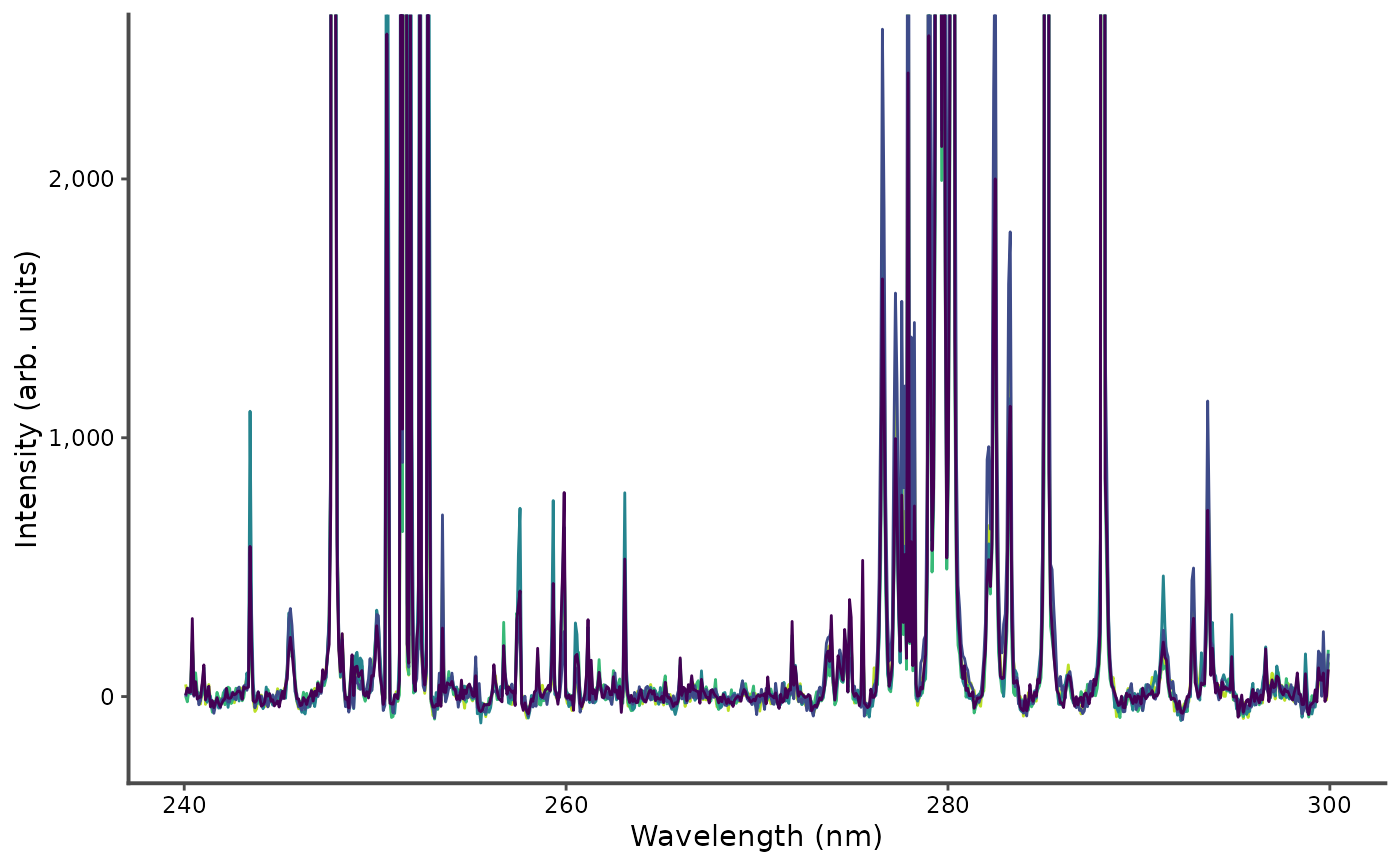
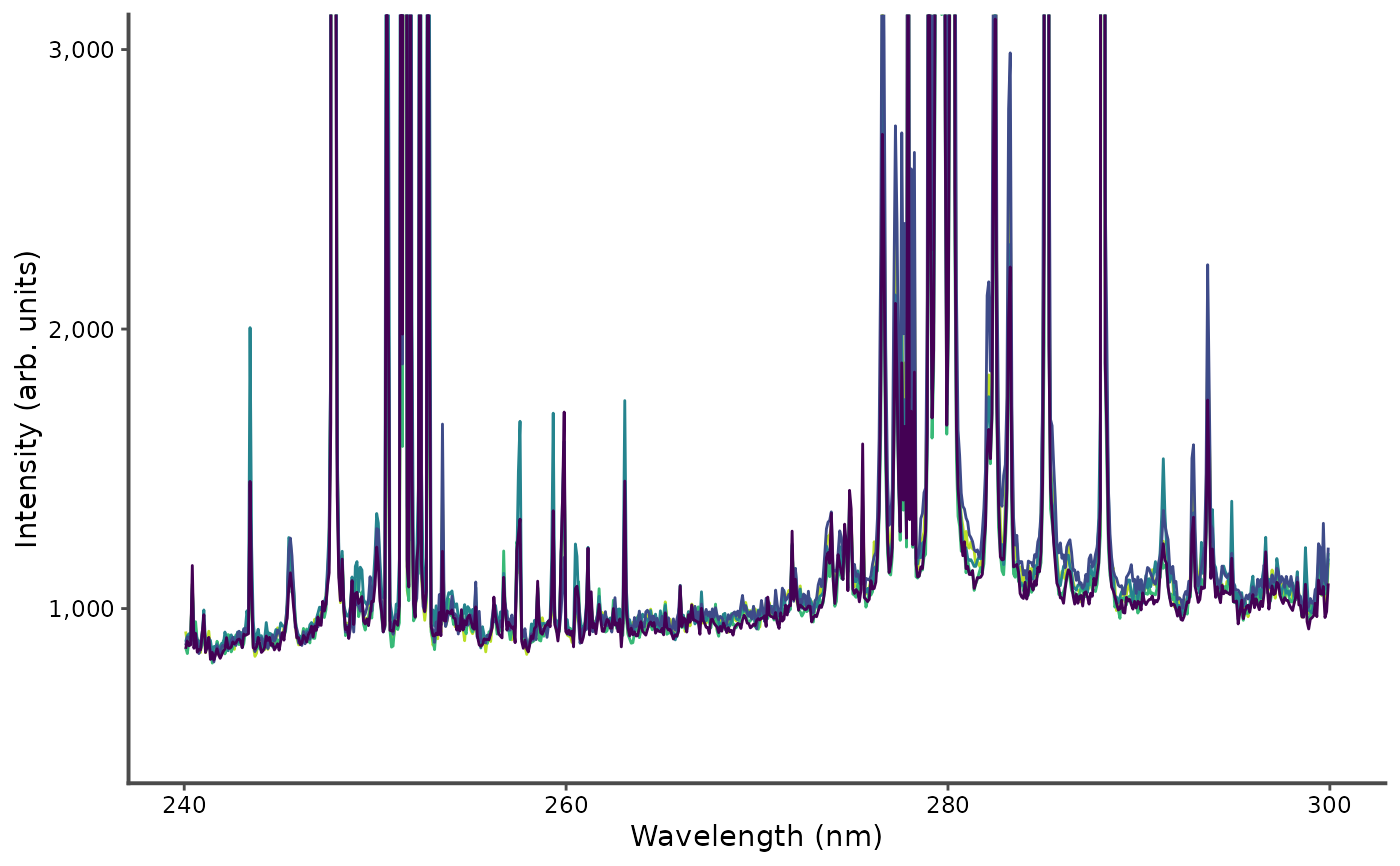
# five spectra between 240 and 300 nm, before and after the baseline correction
wl <- suppressWarnings(as.numeric(names(forageLIBS)))
region <- forageLIBS[1:5, c(2, which(wl > 240 & wl < 300))]
corrected <- recipe(~ ., data = region) |>
update_role(Sample, new_role = "id") |>
step_baseline(all_predictors(), method = "arpls", lambda = 1e5) |>
prep() |>
bake(new_data = NULL)
plot_spectra(region, id = Sample) +
ggplot2::coord_cartesian(ylim = c(500, 3000))
 plot_spectra(corrected, id = Sample) +
ggplot2::coord_cartesian(ylim = c(-200, 2500))
plot_spectra(corrected, id = Sample) +
ggplot2::coord_cartesian(ylim = c(-200, 2500))